
Chapter 14: United at last?
The air inside the Paper House was thick with the scent of lye and the sudden, desperate hope of the found. Taeyeon moved with a frantic, twitchy energy, her movements jagged and uncoordinated. There was a phantom ticking in her ears—not the Swiss movement of the watch she’d traded, but a cold, rhythmic pulse. She felt an irrational, clawing urge to move, to run, to drag Jessica out of Milan before the shadows of something unknown could realize that they were gone.
“We have to clean this off, Jess,” Taeyeon whispered, her voice tight with a panic she couldn’t name. She poured the lukewarm water from the thermos over a scrap of clean cloth, scrubbing at the indigo on Jessica’s neck with a ferocity that made the other woman flinch. “We have to be clean. We can’t take the Blue with us.”
Jessica reached out, catching Taeyeon’s trembling hands. “Taengoo, slow down. We’re here. We’re safe.”
“We aren’t safe yet,” Taeyeon snapped, her eyes wide and unfocused. For a split second, the cardboard walls of the settlement flickered, replaced by the sterile, white-tiled walls. She smelled bleach instead of rain. She blinked, and the vision receded, but the urgency remained like an iron band around her chest. “We’re going home. The house. The one we dreamt of.”
They sat on the floor, surrounded by the remnants of Jessica’s decade of survival. Between the scrubbing and the shared, ragged breaths, they found the fragments of the girls they used to be. The half-sentences and the taste of the sour peaches and the way the light used to hit the orphanage wall at 4:00 PM. It was a frantic attempt to bridge fifteen years in sixty minutes.
When Taeyeon finally leaned in, the kiss tasted of salt, ginger tea, and the metallic tang of the factory. It was a desperate way to prove they were both still made of flesh and blood. But even as Jessica’s heart beat against hers, Taeyeon felt that cold, clinical beep echoing in her mind. Hurry, the vision whispered. She’s running out of air.
“Pack what you can,” Taeyeon pleaded, standing up so abruptly she nearly toppled the small stove. “We’re leaving Italy tonight. I have enough cash for private transit. We’re going back to Korea, to the coast.”
They started off soon after. The transition was a blur of high-speed motion and flickering lights. Taeyeon moved through airports and train stations like a woman possessed, her still indigo-tainted fingers hidden in the pockets of a new, nondescript coat. She didn’t look at the displays; she looked at Jessica, who seemed to be growing paler, more translucent with every mile they put between themselves and Milan.
Soon, the grey slush of Milan was replaced by the sharp, salt-heavy air of the Korean coastline near Namhae. Taeyeon didn’t wait. She took Jessica to a small, secluded cottage perched on a cliffside. It was weathered and old, but it had a heavy timber frame and a garden that had gone to seed.
Finally, Taeyeon felt she can breathe a sigh of relief. As if the time slowed down again and they could finally lose themselves to the childhood glee they once experienced.
“It needs paint,” Jessica says, standing back with her hands on her hips, surveying the peeling frame like it’s an argument she intends to win. “The whole thing needs paint, actually.”
“Just the door,” Taeyeon says. “The door is the only part that matters.”
She says it like a joke, light, thrown over her shoulder as she digs through the rusted shed out back for anything resembling a paintbrush — but underneath the lightness is something that has been buried for fifteen years and is only now allowed to surface: a promise made under a striped umbrella, sealed with a toy ring bought for a hundred won, that had somehow survived every version of both their lives that came after it.
She finds a can of paint half-full and crusted at the rim, the label long gone, and when she pries it open the color inside is exactly what she needed it to be — a deep, saturated cerulean, blue like the hour just before a summer storm, blue like the ache behind her sternum every time she used to think Jessica’s name.
Jessica watches her paint it on with a brush that’s shedding bristles, uneven strokes, drips running down toward the doorstep.
“That’s the worst paint job I’ve ever seen,” she says, but she’s laughing, and the laugh cracks slightly in the middle, the way laughs do when there’s something enormous sitting just behind them.
“It’s not supposed to be perfect,” Taeyeon says. “It’s supposed to be blue.”
When she finishes, she stands back, paint on her knuckles, on her wrist, a smear of it along her jaw where she wiped away sweat without thinking. The door gleams wet in the low afternoon light. Behind them the sea keeps its slow rhythm against the rocks, in and out, in and out, patient as something that has all the time in the world.
“We’ll have the wedding in the garden,” Taeyeon says, already walking the weeded, overgrown patch of yard in her mind, already seeing what isn’t there yet — trellises, some kind of white flower she can’t name but knows will smell like the jasmine plant in that Milan grocery store, string lights strung low enough to catch in Jessica’s hair. “Small. Just us. And the pastor.”
“You’ve already planned the whole thing.”
“I’ve had fifteen years to plan it.”
Jessica comes and stands beside her at the doorway, close enough that their shoulders touch, and for a moment neither of them says anything. The wind picks up, carrying the smell of salt and wet stone, and underneath it — faint, wrong, a thread that doesn’t belong to this place — something sharp and clinical. Bleach. Taeyeon frowns, the sensation gone as quickly as it came.
“Did you smell that?” she asks.
“Smell what?”
“Nothing.” She shakes her head. “Nothing. I thought—” She doesn’t finish. The thought slides away from her like water off the paint-wet door, and she lets it go, because Jessica is here, finally not a photograph in a drawer, and nothing else in the world is supposed to matter more than that.
They stand at the threshold of the blue door together, and somewhere far off — so far off it’s easy to mistake for the sound of the tide — something begins to hiss, and fall, and hiss again, rhythmic as breathing, patient as a machine that has been waiting a long time for permission to stop.
“Our house, Jess,” Taeyeon said, her voice finally softening as she pulled Jessica into the shade of the porch. She paused, her eyes searching Jessica’s face, which looked so peaceful yet so frighteningly still. “No one will ever separate us again. No more adoptions, no more glass, no more blue.”
Jessica leaned her head on Taeyeon’s shoulder, “Yes”…her eyes fixed on the horizon where the sea met the sky. “A wedding in the garden,” she murmured, her voice sounding like a distant echo. “I can almost see the jasmines, Taengoo.”
As Taeyeon held her, the sound of the ocean began to distort. The crashing waves started to sound like the rhythmic whoosh-hiss of a machine breathing for someone who couldn’t. She squeezed Jessica tighter, terrified that if she let go, the blue door would dissolve back into a memory again.
…
…
There is no diary entry for today.
The realization comes to Jessica slowly, the way cold water finds a crack in stone — not all at once, but seeping, patient, until the whole thing splits open.
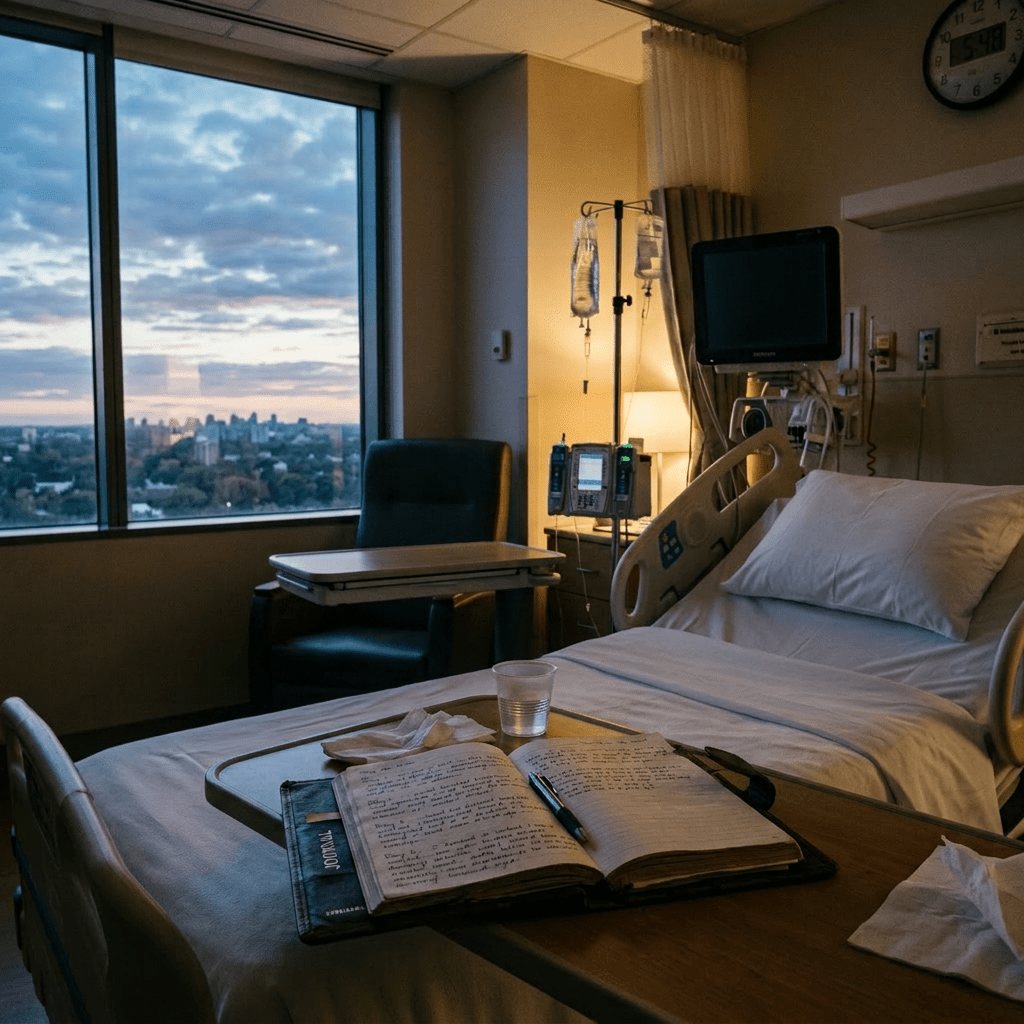
She has been reading for six hours, and crying, in that unbearable silence. Six hours of Taeyeon’s handwriting, small and slanted and stubbornly neat even when the ink smudged from what must have been tears, or rain, or both. She started at the beginning because she didn’t know how else to hold this thing — this leather-bound brick of a diary that smelled like the inside of Taeyeon’s old work bag, like paper and faint perfume and something Jessica can only describe as her. She read about Seoul. About the corner office with the view Taeyeon said made her feel like a bird trapped behind glass. About a grainy photograph kept in a drawer for fifteen years, and a plastic ring wrapped in tissue paper like a relic too precious to touch with bare hands.
She read about herself. A version of herself Taeyeon had built out of memory and hope and refused to let go of, even as the entries grew shorter, the handwriting more urgent, the dates pressing closer and closer together like footsteps quickening toward something.
The last entry is dated three days ago.
After that: nothing. Just blank pages, cream and smooth and waiting, page after page of a future that was supposed to be written and never was.
Jessica turns one of those blank pages. Then another. Her fingers move slower each time, as if some part of her still believes that if she turns enough of them, carefully enough, she’ll find more of Taeyeon’s handwriting hiding somewhere in the whiteness — a margin note, a stray sentence, anything. There is nothing.
She closes the diary very carefully and looks up.
The machine beside the bed hisses and falls, hisses and falls. That’s the sound — she knows now, has known for six hours, will know for the rest of her life — that’s what a ventilator sounds like when you stop being able to hear it as background noise and start hearing it as a countdown.
Somewhere in that dying, dreaming place Taeyeon had built for herself — a Milan of grey skylines and blue basements, a mill floor slick with indigo dust, a cottage with a door the color of the sea — this had been the ocean. This had been the tide Taeyeon heard, eyes half-open, unseeing: listen, can you hear it, we’re almost there. Though she could not have known, as if Jessica could hear it too, in a way you know a thing without being told it. It was never water. It was this. Breathing for her, in and out, patient as something that has all the time in the world and none of it, both at once.
There had only been this: she had reached Milan. That much was true — Bovisa, the grey skyline, the language she couldn’t speak, all of it real. She had found Jessica, or close enough to it. Not a rescue from some lightless underground horror, not a descent into a place stitched together out of cardboard and desperation — just an address. A denim finishing workshop on the edge of the old rail yards, legal in the way things are legal when no one asks too many questions, hard on the hands and harder on the lungs by the end of a long shift, but ordinary. Survivable. Jessica had a small rented room above a bakery, a landlady who overcharged her for the hot water, a job that left her too tired most nights to do anything but sleep. Nothing mythic. Nothing that needed saving in the way Taeyeon’s mind had apparently decided it did.
The Blue Lung, the toxic vats, the corrupt foreman who had to be paid off in secret, the settlement of paper houses burning to ash — none of it happened. Not like that. The job had been hard and underpaid and nothing to be proud of, but it had never been a war zone. Somewhere underneath the horror of what Taeyeon had imagined, there was a mind that loved someone that much to imagine her enduring hell than to imagine her simply, quietly, surviving without it noticing.
The diary places her four buildings from where Jessica actually lived. Close enough that, on the right evening, at the right hour, they might have passed each other on the street without either one knowing it. Taeyeon had gotten the address three days before the accident. She hadn’t gone to the door yet — there’s an entry about standing across the street from the bakery for almost an hour, rehearsing what to say, deciding she wasn’t ready, that she needed one more day to become someone worth opening that door to.
She never got the day.
On her fourth sleepless night in Milan, running on nothing but coffee and the kind of hope that eats a person hollow from the inside, Taeyeon had stepped off a curb near Porta Romana without looking, or without looking long enough, and a delivery van hadn’t been able to stop in time.
A brain bleed. A coma. An Italian hospital that stabilized her. A tote bag recovered from the accident site, brought with the rest of her belongings. A diary inside it, and inside the diary’s back cover, in handwriting from years ago, faded but legible, an old landline number Jessica hadn’t used in a decade and had never once thought to disconnect.
Someone had called it. Someone had asked, gently, if she could come.
Jessica had not known, until three days ago, that Taeyeon had ever stopped thinking about her.
Fifteen years. Fifteen years since two eight-year-olds sat under a striped umbrella in Incheon, weaving toy rings out of hundred-won-store elastic, and Jessica had said, half-joking and half-not, the way children say things they don’t yet know they mean forever: We’ll live in a house with a blue door. I promise. She hadn’t thought of that promise in a decade. She had built an entire life on top of the place where that memory used to live — an apartment with bad water pressure, a job with fluorescent lights, a version of herself that got up and went to work and came home and didn’t think about Incheon, didn’t think about summer, didn’t think about a girl with a paper compass for a heart who used to follow her everywhere like her own shadow had chosen to walk beside her instead of behind.
Jessica presses the diary flat against her chest, the way she might press a hand to a wound to try to stop it bleeding, and for the first time in six hours she lets the sound come out of her — not a sob, not yet, just a long, cracked exhale, the kind that comes from a place that has been holding its breath for fifteen years without knowing it was holding anything at all.
“You were four buildings away,” she says, barely audible under the hiss and fall of the machine. “You were four buildings away.”
She thinks of Taeyeon standing across the street from a bakery she herself had walked past a thousand times, deciding she wasn’t ready yet, that she needed to be someone better before she knocked. Some deep and frightened part of Taeyeon had needed the ordeal to be enormous, because if it was enormous, then turning back for one more day might have been forgivable. If it was enormous, she might still have time.
You didn’t need to earn it, Jessica thinks, staring at the number climbing its small green mountains on the monitor. You never needed to earn any of it. You just needed to knock.
The heart monitor keeps its rhythm, indifferent, patient, telling the only truth left in the room.
Outside the window, Seoul is grey with early morning, the kind of pale, ordinary light that doesn’t care what it’s illuminating. Jessica looks at Taeyeon’s still face — the tube taped along her jaw, the bruise-dark hollows beneath her closed eyes, the paper-thin eyelids that used to crinkle, she remembers now, suddenly, achingly, when she laughed too hard at something stupid.
She just sits. And reads the blank pages again, one by one, as if reading them slowly enough might somehow turn them into an answer.
While Jessica is still turning pages, still hunting for handwriting that isn’t there anymore, when the night nurse comes in to check the lines and pauses at the sight of the open book in her lap. “She used to think she was writing in that,” the nurse says, careful, the way people are careful around grief they don’t want to make heavier. “Early on, her hand would move like this—” she mimics it, small circular motions against her own palm, “—like she was holding a pen. We thought it was just reflexive at first. Muscle memory. But it kept happening, night after night, and every time we managed to make out what she was murmuring under the mask, it was the same three words. Just that. Over and over.” The nurse hesitates. “Toward the end it was almost constant. Like she couldn’t stop once she started.”
Jessica looks down at the diary’s last real entry — three days old, the ink dry, the sentence about Bovisa cut off mid-thought by whatever came next — and understands, with a slow and awful clarity, that somewhere inside the dream, Taeyeon believed she was still writing. Believed she was filling page after page in that same small, careful hand, adding one more I love you every time the fear got too large to hold silently. But there was no pen. There were no pages. There was only a woman lying still in a hospital bed, her fingers twitching faintly against the sheet, saying the only sentence she had left to say, more times than anyone thought to count, to a room that everyone assumed was empty.
The machine hisses. Falls. Hisses again.
…
And then, somewhere in the grey hour before the sun fully commits to rising, the rhythm changes.
It isn’t dramatic. That’s the strange, unbearable thing about it — it doesn’t announce itself the way it does in films, no great crescendo, no final gasp. The hiss comes, and falls, and the small green mountains on the screen begin to flatten, one by one, like a tide finally deciding it has come in far enough and has no more reason to climb. Somewhere behind her a sound begins that Jessica will spend the rest of her life trying not to remember and never quite managing to forget, and the room fills with quick footsteps, and hands that are not hers reaching past her toward the bed, and voices pitched low and urgent that she doesn’t have room left to hear.
She doesn’t move from the chair. She keeps the diary pressed to her chest with both arms, the way she used to hold a pillow as a child during a storm, and she watches — not the hands, not the machines, not the sudden crowded motion of people trying to hold a life in place with wires and hope — she watches the window instead, where the light has finally gone from grey to something almost gold, spilling soft and indifferent across the floor tiles, across her shoes, across the closed cover of a book that will never have another page filled in it.
Somewhere far off, or perhaps very close, she thinks she can hear the ocean. Not the machine’s ocean — a real one, distant and patient, the kind that has always been there whether anyone is drowning in it or not.
A teardrop fell into that ocean, but without making a rainbow against the golden hue.
You’re at the door now, she thinks. I know you are. I just wasn’t fast enough to walk through it with you.
She lets herself remember, then. Incheon, the striped umbrella, the smell of cheap plastic melting slightly in the July heat as they twisted two rings out of a single strip of hundred-won elastic. The two of them at ten, at twelve, passing notes across an orphanage dormitory in a code only they understood. The last afternoon before everything was quietly, deliberately taken apart by adults who thought they were doing the responsible thing. All the years after that Jessica had spent believing otherwise. All the years she would now spend knowing she’d been wrong, and understanding, with the cruelty of hindsight, that a life could have been built in the space where fifteen years of silence had been instead — a small apartment somewhere, an ordinary door, nothing as grand as a coastline or a garden, just two names on a single mailbox and the unremarkable miracle of coming home to the same person every evening.
She reaches into her coat pocket, the same one she’s kept for fifteen years, without quite knowing why, and takes out the plastic ring — faded now, nearly white where it had once been some cheerful, forgotten color, its edges softened from a decade of being carried rather than worn. Her hands are steadier than she expects them to be. She slides it onto her finger, all the way down, the way an eight-year-old once slid its twin onto Taeyeon’s, and holds her hand very still afterward, watching the pale morning light catch on the small imperfect band as if it were something far more precious than a million won could ever buy.
The gold light keeps spilling in, unhurried, the way morning always does, whether or not it has anywhere left to shine.


Leave a comment