
Chapter 12: Blue recognition (I)
The transition was not a single moment of decision, but a slow dissolution of Taeyeon’s former self, accelerated by the stinging memory of Jessica’s rejection. The sterile comfort had become suffocating, a curated museum of a life that no longer belonged to her. The next day, Taeyeon stood on the curb wearing the same dark, high-end wool coat she had worn to the Ex-Macello. In her right hand, she gripped the handle of a single leather satchel containing her passport, the remainder of her cash, and a small, worn photograph of a garden. Everything else—the custom suits, the expensive technology, the artifacts of a decade of “success”—had been left in the room.
The “selling” of her old life didn’t happen in a luxurious boutique. It happened in a cramped, smelling second-hand stall near Porta Romana, where an elderly man with a measuring tape around his neck appraised her designer items with clinical indifference. He took the grey wool coat, running his hands over the stitching, and handed her a thick stack of Euros. In exchange, she bought the rough, grey felt trousers and a heavy, oil-stained utility jacket that smelled faintly of old machine grease and cheap tobacco. She bought a knitted beanie, thick socks, and a pair of heavy, reinforced boots that had already been broken in by someone else’s labor. She stripped in the back of the stall, pulling the scratchy wool over her skin, feeling the unfamiliar weight of the clothes. When she looked in the cracked mirror, the consultant from Seoul was gone. She was just another weary body looking for work.
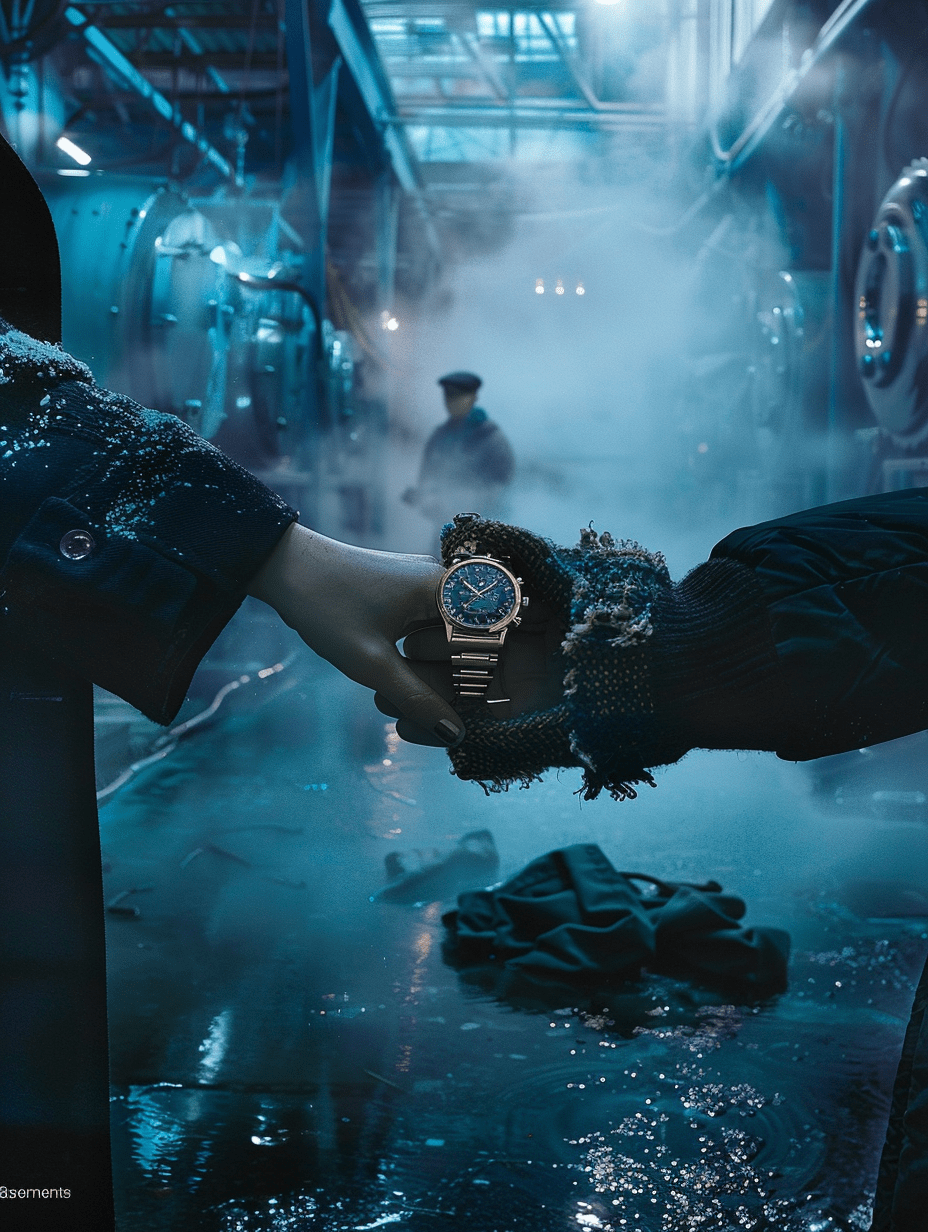
The entrance to the “Blue Basements” was a nondescript steel door behind a wall of overgrown weeds. When the foreman opened it, the heat hit her like a physical blow—a humid, chemical-laden wall of air that tasted of iron and lye. The man, a massive figure named Moretti with skin the color of a bruised plum, didn’t look at her hands. He looked at her face. He saw the high-cheekbones, the expensive haircut hidden under a cheap beanie, and the way she stood—too straight, too poised.
“You’re lost, principessa,” he spat, blocking the doorway. “This isn’t a museum. You want to see the poor? Go to the soup kitchen. You don’t belong in the steam.”
“I need the work,” Taeyeon said, her voice sounding thin against the low, industrial thrum vibrating through the floor.
“Work?” He laughed, a wet, rattling sound. “You wouldn’t last an hour. Look at you… Go home before you get hurt.”
Taeyeon didn’t move. Slowly, she reached into the pocket of her oil-stained jacket. She pulled out her Patek Philippe—the watch she had bought herself after her first million-dollar merger. The rose gold glinted obscenely against the grey grime of the doorway. She held it out to him, the ticking of the delicate Swiss movement drowned out by the roar of the factory.
Moretti’s eyes widened. He snatched it, the weight of the gold nearly making him stumble. He bit the edge of the casing, then looked at her with a new kind of suspicion—one fueled by greed. “This buys you a week of silence. And a spot in the Sanding Room. If you die in there, I’m keeping the watch.” He paused “Also, I am watching you – if you are working for the police or something…” he didn’t finish the sentence, greed overcame fear.
He took Taeyeon inside, and the tone of Taeyeon’s life changed instantly. The silence of the city was replaced by a screaming, mechanical violence.
“We put the new ones in the ‘Sanding Room’ first,” he said, his Italian thick with a dialect she didn’t know, but the meaning was universal. “If your lungs don’t fail, we move you to the vats. The work is hard. If you slow down, you are dead meat. This watch makes no difference here.”
The Sanding Room was Taeyeon’s first glimpse into the true brutality of the system she had analyzed from her high-rise. It was a massive chamber illuminated only by weak, buzzing fluorescent lights, where dozens of workers stood at long tables, manually distressing denim. The sound was deafening—a constant, screaming shhh-shhh-shhh of industrial sandpaper against coarse fabric. The air was thick with micro-fibers of denim and a concentrated, suffocating cloud of indigo dust.
Moretti grabbed Taeyeon by the shoulder, his grip like a vise, and shoved her toward a long, metal workstation coated in a thick layer of indigo silt. He snatched a heavy wooden sanding block, the grit so coarse it looked like crushed glass, and slammed a pair of raw denim jeans onto the table. “You don’t think, you just move,” he barked over the industrial roar, his face inches from hers as he demonstrated a violent, rhythmic downward stroke. He ground the block into the fabric’s seams with a force that made the table shudder, the friction instantly kicking up a cloud of fine blue dust that coated his knuckles. “Back and forth, until the thread bleeds white. Too light, and it’s a waste of my time; too heavy, and you rip the weave and I dock your pay. Keep the rhythm. Don’t stop to breathe—the air isn’t for you.” He shoved the block into her hands, the rough wood biting into her soft palms, and stood over her like a vulture, waiting for her first clumsy strike.
The work was simple, no training manual or playbook needed. The only question was that of survival.
Hour 1: The Sanding Room was a vision of purgatory. Taeyeon was handed a heavy wooden block wrapped in coarse industrial sandpaper. Her task was to distress the seams of raw denim jeans. Within twenty minutes, the skin on her palms felt like it was being flayed. The “Blue Dust”—the fine, pulverized indigo fibers—began to settle on her eyelashes and inside her nostrils. She tried to maintain the “efficiency” she had preached to clients, but the denim was stubborn, the sandpaper biting back into her knuckles.
Hour 2: The heat became an enemy. Without ventilation, the temperature in the basement climbed toward 40°C. Taeyeon’s heavy utility jacket, which had felt protective outside, was now a furnace. Sweat poured down her back, stinging the split lip she had earned at the Macello. Every time she breathed, she felt a sharp, dry tickle in her throat. She slowed down, her arms trembling. Moretti appeared behind her many times, screaming over the roar of the sanders, calling her “useless” and “dead weight.” He kicked her stool away, forcing her to stand on the slick, vibrating floor. Maybe he did not want people to think Taeyeon was any different.
Hour 3: Taeyeon’s breath became a series of jagged, shallow gasps. The indigo dust had turned the moisture in her throat into a thick, blue paste. She felt a wave of nausea so intense she had to lean against the vibrating metal table. Her vision blurred. She watched her hands—once her pride—turn a sickly, bruised violet. She wasn’t “optimizing” anything; she was failing. She ruined three pairs of jeans, the sandpaper tearing through the fabric because her hands were shaking too hard. Moretti docked her pay for the day before she’d even earned it, his voice a constant, degrading lash against her pride.
By this time, the muscles in Taeyeon’s shoulders were screaming, and a fine, persistent cough had settled deep in her chest. Her hands, despite the gloves she wore, were beginning to ache from the repetitive motion. She worked alongside a quiet woman whose entire forearms were a deep, irreversible blue. Taeyeon didn’t dare look around for Jessica; she knew she was on the day shift, and Jessica was a phantom of the night. But every inhalation of the toxic dust was a shared intake, a shared injury. She was no longer a consultant or a ghost; she was a variable in the same equation of survival.
Hour 4: She was moved to the “Rinse Vats” to fetch heavy, sodden bales of fabric. This was the heart of the darkness. The vats were massive concrete pits filled with boiling chemical dyes. The steam was so thick she couldn’t see the person standing three feet away. Here, the air was almost non-existent.
As the day shift began to wind down and the weak lights flickered, signaling the change, a collective sigh of relief seemed to move through the room. Taeyeon stopped sanding, wiping her forehead with the back of her wrist, leaving a smudge of indigo on her skin. She looked at her hands—clean just yesterday—and saw the first, permanent stains of blue gathering under her fingernails. It was a baptism.
The night shift workers began to filter in, a stream of exhausted faces swapping places with the daytime crew. They moved with the same low, practiced efficiency. Taeyeon stayed back, melting into the shadows by the industrial vents, watching. She didn’t expect to see her, not in this room, but her heart still accelerated.
Then, she saw the shift leader in the Sanding Room pull a worker aside. It was a woman with a slight limp, her posture rigid. She had a faded beanie pulled low over her head. Jessica.
She was positioned at the edge of the furthest vat, her silhouette barely visible through the swirling, blue-tinted vapor. Taeyeon stopped, a heavy bale of wet denim slipping from her weakened grip and splashing into the muck.
Jessica was unrecognizable from the girl in the garden. She was drenched in a terrifying combination of sweat and condensation, her thin shirt clinging to a frame that looked dangerously brittle. She was heaving, her chest sinking deep with every agonizing breath, her head tilted back as she tried to find a pocket of clean air that wasn’t there. Her indigo-stained hands were hooked like claws into the edge of the vat, her knuckles white, her skin slick with the toxic moisture.
She looked worse than she had outside the paper house. The antibiotics Taeyeon had left were likely used up, and the fever sweat was visible on her hairline. She was moving slowly, favoring her bruised arm, and the foreman was berating her for her pace. Taeyeon watched Jessica take the sandpaper, her indigo-stained hand gripping the block with a white-knuckled desperation.
Even after years in this hell, Jessica wasn’t “used to it.” She was suffering exactly as Taeyeon was—the same panting, the same frantic struggle for oxygen, the same glazed look of a soul being eroded by the hour. Jessica’s eyes were closed, her face contorted in a silent, rhythmic endurance of pain. She looked like a queen being drowned in a sea of ink.
Taeyeon stood frozen, the silk scarf she had tucked inside her utility jacket pressing against her heart. She was here. She was breathing the same dust. But she was still a ghost, separated not by class anymore, but by silence.
Taeyeon watched, her own lungs screaming, her heart breaking under the weight of the realization. This wasn’t a job; it was a slow-motion execution. Taeyeon realized she didn’t just want to be Jessica’s equal. She wanted to be her shield.
Diary Entry: October 30th
Location: “The Grey Barracks” (a room near the Macello)
My lungs feel like they’re filled with crushed glass. Every breath is a blue fire. I gave him the watch, but it didn’t buy me an entry; it bought me a front-row seat to the end of the world. Seeing her at the vats… it wasn’t a reunion. It was a haunting. She is dying in front of me, one bale of denim at a time, and I am too weak to even lift the fabric. My hands are raw and shaking. I failed today at everything I tried to do, but I succeeded in one thing: I finally know what ‘cost’ means. It’s the sound of her trying to breathe through the steam. I’m going back tomorrow. I have nothing left to trade but my life. I will get you out of there, Jess. I love you. I love you. I love you. I love you. I love you. I love you.
 be-ayan
Leave a comment