
Chapter 9: Labyrinth
The journey to the southern edge of the city was more than a trek across Milan; it was a descent through the strata of a world Taeyeon had spent her entire career helping to build, yet never once looked at. She took the last tram until the tracks simply gave up, leaving her at the mouth of the Ex-Macello district. Here, the streetlights were flickering relics, casting long, shivering shadows over a landscape of rusted iron and cracked concrete.
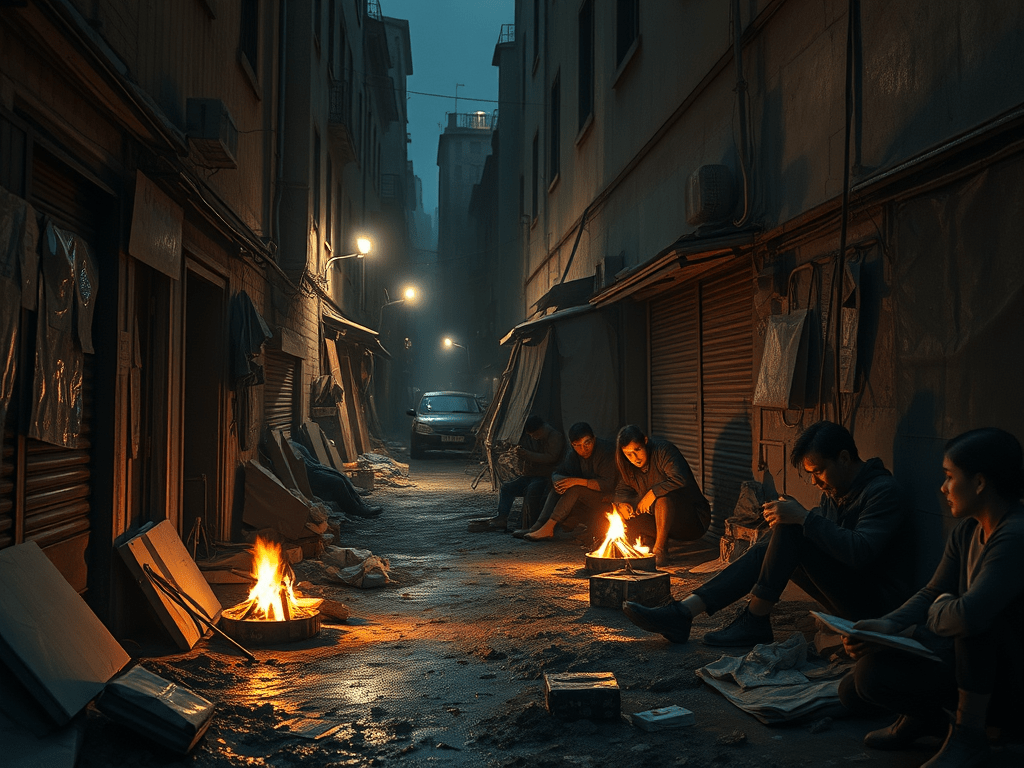
As she stepped into the ruins of the old slaughterhouse, the “Paper House” settlement revealed itself—not as a collection of tents, but as a dense, suffocating maze. This was a city built of remnants. Taeyeon’s eyes, usually calculating ROI and efficiency, were now forced to witness the brutal, heartbreaking genius of survival.
The contrast with her own life was a physical blow. Just that morning, she had woken up in a suite where the temperature was digitally controlled to the degree, surrounded by soundproofed glass and Egyptian cotton. Here, the “walls” were made of double-thick corrugated cardboard from luxury German appliance brands—the very companies she had advised on global supply chain logistics. To see a refrigerator box she might have tracked in a spreadsheet now serving as the only barrier between a human being and the biting Milanese wind that made her stomach turn.
The conditions were a sensory assault. The air was thick with the acrid scent of cheap coal, wet paper, and the metallic tang of the nearby tracks. She walked down “streets” no wider than her shoulders, where the ground was a slurry of grey mud and discarded plastic. She saw residents huddled over small fires contained in oil drums, their faces etched with a permanent, grey exhaustion. She saw a mother trying to boil water over a flickering flame, her movements slow and mechanical, her eyes never leaving the damp cardboard ceiling of her home as if she were willing it not to collapse.
In her world, a “structural weakness” was a slide in a PowerPoint presentation. Here, it was a child coughing into a rag in the next “room,” the sound vibrating through the paper walls. Here, a “resource shortage” wasn’t a delay in a shipping port; it was the man she saw shivering under a layer of blue polyethylene, his breath hitching in a way that suggested his lungs were already half-full of the city’s winter damp. It was a world held together by blue industrial tape and a collective, silent agreement to remain invisible to the city of stone and glass just a few miles away.
Taeyeon pushed deeper, her designer boots sinking into the muck, the silk lining of her coat feeling like a mockery. The alleyways narrowed until the sky was just a thin, bruised ribbon above her. The smell of woodsmoke began to thin, replaced by a hauntingly familiar sweetness. It was faint at first, a delicate thread of jasmine weaving through the stench of damp rot and lye.
The deeper Taeyeon ventured, the more the labyrinth seemed to actively resist her. Every turn looked identical—a repetitive blur of “Heavy Duty” and “Fragile” stamps on damp brown surfaces—creating a sensory deprivation that made her fever spike. She found herself stumbling into dead ends where the “walls” were nothing more than hung laundry and rusted bedframes, forced to retreat under the suspicious, hollow-eyed glares of men who looked like they hadn’t seen a woman in a designer coat since the world was whole. Twice, she nearly lost her footing in the slick, oil-blackened mud, her palms scraping against the rough, freezing edges of a refrigerator carton. The silence here wasn’t peaceful; it was a heavy, watchful pressure, broken only by the rhythmic slap-slap of water dripping onto plastic and the distant, haunting sound of someone whistling a melody that died before it could finish.
Her mind tried to map the chaos, but the settlement was an organic, shifting thing that defied logic. She began to feel a mounting, claustrophobic panic, a fear that she was circling the same block of cardboard ghosts, destined to never find the exit. The cold was beginning to numb her face, and the scent of jasmine, which had been so sharp in the grocery store, was now being smothered by the smell of burning rubber and stale sweat. She stopped at a three-way junction of makeshift corridors, her breath coming in ragged gasps, her confidence shattering. For a moment, she stood in the center of that papery graveyard, feeling the sheer, crushing weight of fifteen years of distance. She was a woman who solved global problems for a living, yet she couldn’t even navigate a hundred yards of cardboard to find the one person who mattered.
It was only when she slumped against a stack of wooden pallets, ready to give up, that the wind performed a final, desperate mercy. It whipped through a gap in the slaughterhouse’s jagged roof, carrying a sudden, concentrated burst of sweetness that cut through the smog like a blade. It wasn’t just a scent; it was a memory in physical form, warm and heady. Taeyeon followed it blindly, no longer looking at her feet or the residents, but simply chasing that invisible thread. She pushed past a heavy curtain of blue polyethylene and emerged into a small, secluded cul-de-sac at the very edge of the ruins.
Then, at the very end of a dead-end corridor of stacked crates, she saw it.
And there, tucked against a soot-stained stone pillar, was the door—the deep, jagged indigo blue that looked like a piece of the night sky had been pinned to the earth. It wasn’t just a slab of cardboard. Someone had spent hours—perhaps weeks—meticulously painting it. Using what looked like leftover indigo dye and cheap acrylics, they had transformed the brown surface into a deep, vibrant blue. It was a jagged, handmade portal that looked like a blue bruise against the grey ruins.
Paranmun.
Taeyeon’s breath hitched. She didn’t need a sign. The scent of jasmine was pouring through the gaps in the cardboard like a physical plea. She stood frozen, her hand hovering inches from the blue-painted surface, her heart hammering against her ribs with a violence that made her dizzy.
Taeyeon stood before that jagged blue portal, her hand suspended in the freezing air, paralyzed by a terror no boardroom or billion-dollar merger had ever inspired. Now that the distance was measured in inches rather than years, the reality of her own “success” felt like a lead weight in her chest. She looked down at her coat—the soft, grey wool that cost more than a year of a worker’s life in this place—and felt a sudden, violent urge to strip it off and bury it in the mud. She tried to smooth her hair, her fingers trembling so violently they caught in the tangled strands, realizing with a sickening jolt that she was terrified of her own reflection in Jessica’s eyes. She was the one who had stayed in the light; she was the one who had eaten the ramyun in the glass towers while this paper city was being built.
She closed her eyes, trying to find the words she had rehearsed for a decade, but they all felt like ash. I’m sorry felt too small; I’m here felt like an insult. She began to breathe in shallow, jagged bursts, her consultant’s brain frantically trying to calculate the “best-case scenario” for a reunion with a ghost. Would Jessica scream? Would she look at Taeyeon with the same hollow indifference she had seen in the eyes of the other residents? Or worse—would she look at Taeyeon and see only the girl who stood silent at the gate fifteen years ago? Taeyeon pressed her forehead against the cold, damp cardboard of the door frame, the scent of jasmine now so thick it felt like it was filling her lungs, drowning out the fever. She wasn’t preparing to meet a friend; she was preparing to face the jury of her own conscience, standing at the threshold of the only door she had ever truly been afraid to knock on.
Then, the “door” creaked.
Taeyeon instinctively recoiled into the shadows of a stack of pallets, her heart stopping. A figure emerged.
It was Jessica.
Taeyeon’s first instinct was to scream her name, but the sight of her choked the sound in her throat. This wasn’t the “Regal Heart” of the orphanage. The woman stepping out was a harrowing reflection of the hardship she had endured. Jessica looked fragile, as if a strong gust of wind might shatter her. Her skin was a sickly, translucent pale, slick with a cold, unhealthy sweat that made her hair mat against her forehead.
She was bruised. A dark, yellowish-purple mark bloomed across her cheekbone, and her hands—the hands that used to weave jasmine crowns—were raw and swollen. Her fingernails were stained a permanent, ink-dark indigo, the skin around them cracked and red from lye and the brutal labor of the “Blue Basements.” She moved with a slight, painful limp, one hand clutching a threadbare shawl around her shivering frame. She looked small. She looked broken.
But as Jessica stopped to adjust a piece of blue tape on her “wall,” she tilted her head back to catch a breath of the cold air. For a fleeting second, the moonlight caught the line of her jaw. In that tilt of the head, in the stubborn, unyielding set of her shoulders despite the obvious pain, Taeyeon saw her. The regal girl was still there, buried deep beneath the indigo dust and the scars of the Paper House. She was a queen in a ruined kingdom, refusing to bow even as her body failed her.
Jessica didn’t see Taeyeon. She looked toward the distant lights of the city for a moment, her eyes hollow and distant, before turning back and disappearing into the blue-painted darkness of her home.
The “door” closed with a soft, papery thud.
“I saw you, Jess. I saw what the world did to you while I was busy looking at the stars. You’re living in a house of tape, and your beautiful hands… they’re stained with the labor I never had to touch. I’m standing here in the mud, and I’m finally seeing the cost of my ‘success.’ I’m not leaving. I’m going to walk through that blue door, and I’m going to bring you home, even if I have to burn this whole paper city down to do it. I love you. I love you. I love you. I love you.”
 be-ayan
Leave a comment