
Chapter 8: Scent of Jasmine
The search had become a mechanical grind, a ritual of failure that had lasted for three agonizing weeks. Taeyeon had treated the backstreets of Milan like a fractured dataset to be scrubbed, mapping every “Sartoria” and industrial laundry on the city’s southern fringe. Her body was vibrating with a low-grade fever, her stamina pushed to a point where her vision often frayed at the edges. She wasn’t looking for a meal when she turned down the narrow cobblestone alley near Porta Romana; she was tracking a specific type of industrial chemical pallet she had seen in a blurred photo of the Ex-Macello district.
Then, the wind shifted.
Through the damp, metallic scent of the Milanese winter, a sharp, spicy ghost of a smell drifted toward her. It was the pungent, toasted-garlic-and-chili aroma of Shin Ramyun. To anyone else, it was just the scent of a quick lunch; to Taeyeon, it was the ritual fuel of her former life. It was the smell of 2 AM deadlines in Seoul, of steam rising from a plastic cup while she sat in a glass office, staring at risk assessments until the sun rose. It was the smell of being “successful” and utterly alone.
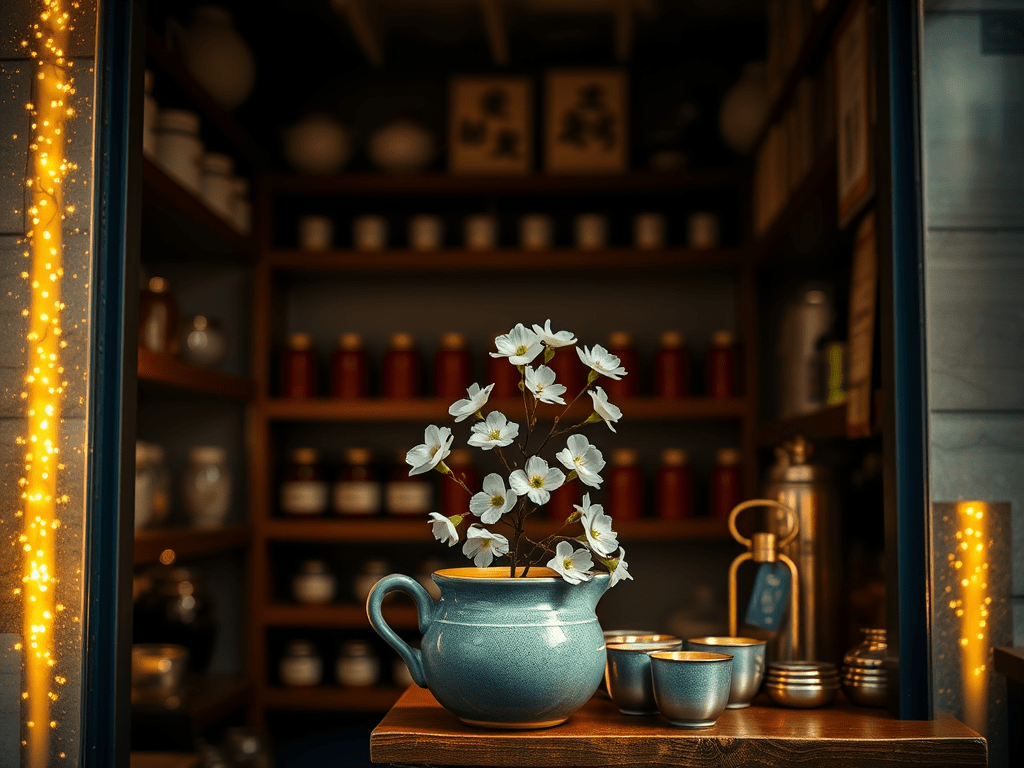
She followed the scent to a tiny, fogged-up storefront with a faded sticker of a red pepper on the glass. Inside, the shop was a cramped, golden-lit sanctuary. Shelves were packed with yellow bags of tea, jars of gochujang, and rows of silver-topped ramyun cups.
Taeyeon’s eyes scanned the room, and then she froze. Next to a stack of dried seaweed sat a small ceramic pot. The jasmine blossoms were small, but their fragrance was a violent contrast to the savory smell of the shop. It was the exact, heady scent of the laundry yard at the orphanage.
“You look like you’ve seen a ghost, child,” a voice said in Korean. An elderly woman stepped out from behind a curtain, her eyes sharp and suspicious.
Taeyeon pointed a trembling finger at the plant. “This jasmine… where did it come from? It shouldn’t be blooming in February.”
The woman went back to organizing her jars, her movements slow and deliberate. “Plants grow where they are loved. That one is just a guest.”
“Please, who brings this here?” Taeyeon said, her voice cracking. “A girl brings this here, doesn’t she?”
The shopkeeper stopped. She looked at Taeyeon’s expensive, mud-splattered coat and her hollowed-out eyes. She reached under the counter and pulled out a small, steaming bowl of ramyun, pushing it toward Taeyeon. “You’re shaking. Eat. No one finds anything on an empty heart.”
Taeyeon ate, the salt and spice burning her throat. She thought of the nights she had eaten this same meal in a boardroom, thinking she was winning at life, while the girl who grew jasmine was disappearing into the earth.
“The girl who brings the plant,” the woman said finally, her voice dropping to a low hum. “She doesn’t give a real name. The people who live in the ‘Paper Houses’ don’t have names. They only have stories.”
“What does she call herself?” Taeyeon whispered.
The woman leaned over the counter, her eyes searching Taeyeon’s face. “She told me that if anyone ever came looking for her, they wouldn’t use a name. They would ask for Paranmun.”
Taeyeon’s breath hitched. Paranmun. The Blue Door.
The realization didn’t hit her as a single wave; it was a series of electrical tremors that started in the tips of her fingers and climbed toward her heart. For fifteen years, Jessica had been a static image—a girl frozen behind a car window. But hearing that word spoken aloud by a stranger turned the ghost back into a living, breathing woman.
A manic, terrifying heat bloomed in Taeyeon’s chest, overriding the cold of the Milanese winter and the dull ache of her fever. This wasn’t a data point or a risk assessment; this was the “Blue Door” creaking open after she had spent a lifetime hammering it shut. She looked at her hands and saw they were shaking—not from weakness, but from the sudden, violent surge of adrenaline.
As the word hung in the air, the golden light of the shop didn’t fade, but it grew thin, like a piece of silk stretched until it threatened to tear. The sound of the shopkeeper’s breathing became unnaturally loud, a rhythmic, mechanical expansion and contraction that seemed to vibrate in the floorboards beneath Taeyeon’s feet. For a fleeting second, the heat of the ramyun bowl vanished, replaced by a biting, metallic coldness against the center of her chest that made her gasp for air. Then, the ceiling overhead seemed to pulse with a single, sharp flicker of white—like a star dying or a light being switched on in another room—before the scent of jasmine and sesame oil rushed back to anchor her. She was about to stand up when the shopkeeper gestured her to sit down.
“Sit down, child,” the old woman whispered, her voice like dry parchment as she leaned over the counter, the steam from the ramyun curling between them. “If you want to find her, you have to understand where she lives. We call them the Paper Houses. It isn’t a place you’ll find on your fancy maps. It’s a kingdom of cardboard and desperation built into the bones of the old slaughterhouses. To you, a box is just something that carries a TV or a refrigerator, but to them, a box is the difference between freezing and waking up. They take those heavy industrial cartons—the ones with the blue shipping logos—and they reinforce them with plastic sheets and miles of that indigo-stained tape from the mills. It’s a city that breathes, child. The walls are so thin you can hear a heart beating in the next room, and when the winter wind screams off the southern tracks, the whole neighborhood shivers like it’s made of skin instead of paper. It’s a home that can be flattened and carried away in an hour if the police come. It’s a life that leaves no footprint, held together by nothing but tape and the hope that the rain doesn’t fall too hard.”
The shopkeeper’s gaze drifted to the jasmine plant, her eyes softening with a memory that seemed to ache. “I still remember the first time she walked through that door three years ago. It was a Tuesday, pouring rain, and the bell rang so softly I thought it was just the wind. She looked like a ghost draped in rags, her skin already carries that sickly, pale tint you only get when you spend fourteen hours a day in the sunless place. Before she found me, she told me she’d spent months sleeping in the crawlspaces of the central station, working for under-the-table scraps at a laundry that washes the linens for the big hotels. She didn’t ask me for a discount or a handout. She walked straight to that jasmine plant over there—it was half-dead then, yellow and ready for the bin. She touched those leaves with fingers that were stained a permanent, ink-dark indigo, and she paid for a small bag of rice with coins that smelled of lye and metallic dust. Then she looked at me—with eyes that still looked like royalty even though her coat was falling apart—and she said, ‘Please, let me keep it here. I don’t have a window where I’m going, and I don’t want it to forget what the light looks like.’ That was the day I realized she wasn’t just surviving; she was protecting the only piece of her soul that hadn’t turned blue.”
The old woman paused, her hand hovering over the counter as if shielding the jasmine plant from a sudden draft. She leaned in closer, her sharp eyes boring into Taeyeon’s feverish gaze, demanding a price for the final secret.
“You speak the name like it belongs to you,” the shopkeeper whispered. “But that girl… she has been hollowed out by this city. So tell me, child—who is Paranmun to you? Why have you come this way to find a girl who wants to be forgotten?”
Taeyeon felt the salt of the ramyun on her lips and the heat of fifteen years of repressed words rising in her throat. She didn’t look away.
“Paranmun is the only part of me that isn’t a lie,” Taeyeon said, her voice trembling but certain. “She is the girl who grew flowers in a place meant for weeds, and the only person who ever looked at me without calculating my value. To the world, I’m a success, a strategist, a woman who builds towers of glass—but to her, I’m just the girl who sat in the dirt and promised to never let go. She is the ‘Blue Door’ I was supposed to walk through fifteen years ago, the one I let my parents bolt shut while I stood by and watched. She isn’t just a friend or a memory; she is the half of my soul that stayed behind at that orphanage gate. I’ve spent my whole life climbing a mountain just to realize the only air I can breathe is the scent of the jasmine she kept alive for me. If I don’t find her, I’m just a ghost haunting a life I never wanted.”
“And the scent?” the shopkeeper asked, her voice pulling Taeyeon back from the precipice of a memory.
“It was our secret language,” Taeyeon whispered, her eyes never leaving the small white blossoms. “In the orphanage, the world was all grey concrete and lye soap, but Jessica… she found a way to make it bloom. She discovered that the runoff from the laundry vats stayed warm even in the dead of winter, and she used that stolen heat to keep a single patch of jasmine alive against the brick wall. We used to call it our ‘Inner Garden.’ Whenever the directors would pressure me about my grades or my parents would send another cold letter about my ‘future,’ Jessica would pull me into the steam of the laundry yard. She’d crush a petal between her fingers and press it into my palm, telling me that as long as we could smell the jasmine, we hadn’t been erased yet. It was the only thing in that place that didn’t belong to the adults. It was the scent of our ‘Blue Door’—the promise that one day, we’d find a place where the air always smelled like flowers instead of woodsmoke and old stone.
The shopkeeper stayed silent for a long beat, the steam from the rice cooker hissing between them. Then, slowly, she reached out and patted Taeyeon’s hand—a touch that felt like the first bit of warmth Taeyeon had truly felt since arriving in Milan.
“Then go,” the woman said, pointing toward the southern window where the grey sky met the industrial horizon. “Go to the Ex-Macello. I am afraid I dont have anything more to tell than that but I can tell you something that you already know. Look for her and when you find her door, don’t just knock, child. You open that door and you don’t let her close it again.”
“She was here few days back.” the woman continued, oblivious to the world tearing at the edges. “She bought rice and tape. She said the wind is getting through the cracks in the settlement.
Taeyeon gripped the wood of the counter until her knuckles turned white. The trail wasn’t cold; it was scorching. Every second spent standing in this shop felt like a theft. The world around her—the shelves of ramyun, the fogged glass—suddenly felt thin and inconsequential. The only thing that had mass was the fact that Jessica was there. She had breathed this same jasmine-heavy air.
Diary Entry: October 18th Location: Milan, Porta Romana
“She’s calling herself Paranmun… Jess… She’s using our secret door as her shield. The lady at the shop said you were here. But I can smell the jasmine on my coat now. It’s not a memory anymore; it’s a trail. I’m coming to the Paper Houses. I’m going to open that door, once and for all. I love you. I love you. I love you.”
 be-ayan
Leave a comment