
Chapter 5: Denim Threads
The distance between the rusted rail yard and the basement was only a few kilometers on a map, but in the underworld of Milan, it was a journey across different circles of purgatory. To find the “Blue Basements,” Taeyeon had to shed the last of her corporate skin. She stopped looking at the city as a series of logistics and started looking at it as a predatory animal.
The bus journey to the southern fringes was a slow, rattling transition from the Milan of postcards to a city of rust. They sat in the back of a near-empty ATM bus, the engine groaning as it navigated the increasingly narrow streets of the periphery. Outside the window, the elegant stone facades of the center gave way to monotonous concrete housing blocks and skeletal remains of workshops. Gianna sat in stony silence, her gaze fixed on the floor, while Taeyeon watched the world blur through a veil of condensation. Every time the bus screeched to a halt at a deserted stop, the hydraulic hiss of the doors felt like a physical jolt to Taeyeon’s senses, a rhythmic exhale that seemed to sync with the tightening pressure in her own chest. The deeper they moved into the industrial silence of the south, the more the city felt like it was holding its breath, waiting for them to cross the invisible line into the Ex-Macello, where the pavement ended and the secrets began.
By the time they reached the southern pocket of the Ex-Macello district, the sun was a bruised purple smudge behind a layer of leaden clouds.
They headed here because, to Taeyeon’s tactical mind, it was the only place where a ghost could truly stay buried. Once the city’s massive slaughterhouse complex, the district was now a hollowed-out concrete carcass—a sprawling, “off-the-grid” zone where the lack of municipal oversight made it a haven for shadow economies. Gianna had explained that the deep, subterranean cold storage vaults of the old meat-packing plants had been repurposed by the denim syndicates; their thick, windowless walls were perfect for muffling the roar of illegal sandblasting machines and trapping the toxic chemical plumes that would have otherwise alerted the authorities. It was a place where the architecture was designed for silence and death, making it the logical, albeit chilling, final destination for someone trying to disappear into the very floorboards of Milan.
“Gianna didn’t take me to a factory; she took me to a hole in the earth. To get to the indigo, we had to pass through the grease. We started in a ‘dark kitchen’ tucked under a crumbling tenement, where the air was a thick, humid soup of boiling cabbage. It was a screen—a loud, smelly distraction to hide what was happening beneath the floorboards. I pushed through the steam, my eyes searching for a blue tint in the shadows, but found only the grey of exhaustion.
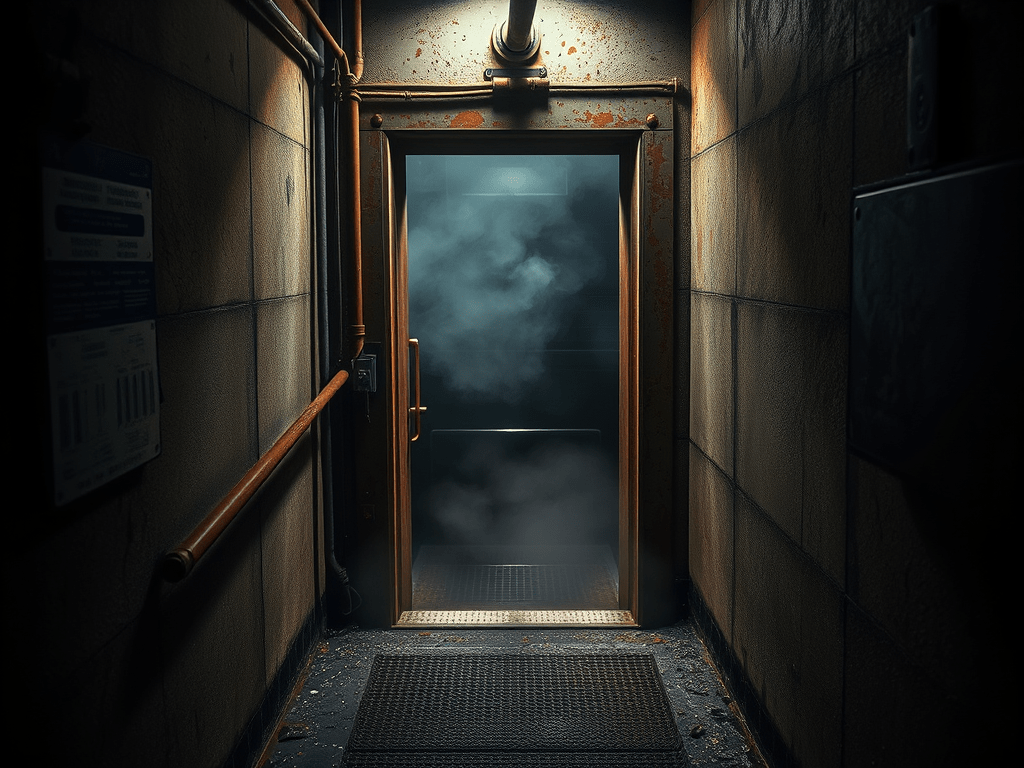
From the kitchen, a rusted service elevator took us down into a clandestine laundry. This was the buffer zone, a place of blinding white steam and the sharp scent of bleach. I showed your photo to a woman folding hospital linens, her arms white with soap-suds. She didn’t look at the face; she looked at the background of the picture and pointed toward a heavy, indigo-stained curtain at the far end of the hall. ‘Il buio blu,’ she whispered. The blue dark.
When I pushed past that curtain, Jess, the world stopped being white. The air turned into a sapphire fog. The ‘Indigo Basement’ wasn’t just a name; it was a physical weight. I realized then that I hadn’t been looking for a workshop. I had been looking for a tomb where they turn living women into blue ghosts.”
“Do not breathe deep, Signorina,” Gianna warned, her voice hushed as they approached a row of condemned tenements. “The air here is heavy. It stays in the hair for weeks.”
The “Blue Basements” were the final stop—the place where the industry hid the jobs that were too toxic for the surface. These were the workshops where raw denim was brought to be aged and distressed to meet the demands of a world that wanted “history” without the wait.
Taeyeon pushed past a heavy indigo-stained plastic curtain. The atmosphere inside was abrasive. A fine, sapphire-colored dust hung in the air like a lethal fog, settling on every surface—the rusted pipes, the flickering fluorescent tubes, and the slumped shoulders of the workers. There were nearly fifty women in the main chamber. They didn’t speak. The only sound was the rhythmic, violent rasp of sandpaper against heavy denim and the high-pitched whine of sandblasting guns.
The reality of the Blue Basement was a landscape of human erasure, where the air was less a gas and more a sapphire grit that clung to every damp surface. The women stood like spectral silhouettes in the dim, flickering light, their frames bowed under the repetitive violence of the work. You could see the toll in the way the indigo silt gathered in the deep creases of their knuckles and frosted their eyelashes, turning their eyes into startling, bloodshot jewels set against bruised, blue-tinted skin. Each time the sandblasting guns hissed, a fresh plume of abrasive powder erupted, coating their paper masks until the filters choked, forcing them to draw shallow, ragged breaths that tasted of metal and pumice. Their hands, stained a permanent, necrotic purple from the vats, moved with a frantic, rhythmic desperation—scrubbing, tearing, and acid-washing the fabric until their own fingerprints were nearly sanded away. It was a factory of ghosts, where the only sign of life was the occasional, heavy vibration of a chest-racking cough that momentarily cleared a small, hollow space in the sapphire fog.
The workers wore makeshift masks—scraps of cloth or cheap paper filters—that were already saturated with blue silt. Their eyes were bloodshot, their eyelashes frosted with the same indigo powder. They looked like statues being slowly sanded away into nothingness.
“I’m looking at them, Jess, and I’m trying to see the process. I used to write reports on ‘operational efficiency,’ but there is no word for this in a boardroom. They are rubbing the life out of the fabric so someone a thousand miles away can look ‘rugged.’ I see a girl in the corner with your height, and for a second, my heart stops. But then she turns, and her eyes are old—too old for her face. I’m terrified that when I find you, I’ll see that same age in your eyes.”
Taeyeon moved through the rows, her boots crunching on the pumice dust that coated the floor like dry snow. She finally approached a woman whose hands were a map of scars and deep indigo stains, her fingers gnarled from years of repetitive motion. Taeyeon showed the photo, her hand trembling.
The worker paused, her wire brush hovering over a pair of jeans. She looked at the photo, then at Taeyeon’s expensive coat, a flicker of something like recognition—or perhaps just pity—crossing her face.
“Lei,” the woman said, her voice a low, gravelly rasp. “The one who works with her head down. She was the only one who didn’t let the dust make her slow. She has a strength… like she is waiting for something.”
“Is she here?” Taeyeon’s voice was a desperate whisper. “In the back?”
The woman shook her head, a puff of blue dust falling from her hair. “No. The owner, he shifted the heavy distress line. He said the chemicals were too strong for this floor. He moved the most ‘capable’ ones—the ones who could handle the acid wash—to the railyards.”
“The railyards?”
“The Case di Carta,” the woman added, looking away as if the name itself was a secret she shouldn’t have shared. “The Paper Houses near the tracks. They use the shipping crates and the old magazines to build the walls there. She went because she said the wind moves the air better. She said she was tired of the basement.”
Jessica wasn’t dying, but she was drifting—moving toward the edge of the city where the structures were as fragile as the people inside them.
As Taeyeon turned to leave, the high-pitched whine of the sandblasting guns began to warp. The sound didn’t just grow louder; it smoothed out, turning into a low, steady thrum that vibrated behind her teeth, a sound that felt rhythmic, almost like a heartbeat that wasn’t hers. For a heartbeat, the indigo dust in the air seemed to settle into a single, horizontal line of light. She felt a phantom chill on the crook of her arm, a fleeting, sharp sensation that felt like a cold drop of rain hitting a vein. She blinked, and the dim, blue-lit basement rushed back, but the floor felt momentarily as soft as a sponge.
She stumbled out of the bunker, the cool night air feeling like a miracle.
Diary Entry: September 24th
Location: Sesto San Giovanni
“I touched the bench where you sat today, Jess. I could feel the coldness of the wood through my gloves. They said you’re at the Paper Houses now—a place made of cardboard and the wind. It sounds so temporary, like you’re ready to vanish the moment someone looks too closely.
The world is thinning out. I tasted the air today and it tasted like… nothing. Not even the chemicals. Just a flat, metallic cold. And I keep hearing that ‘thrum’—the sound of the city’s heart, maybe. Or mine. I’m going to the tracks, Jess. I’m going to find the house made of paper and I’m going to give it a blue door. Just wait for the wind. I love you. I love you.”
 be-ayan
Leave a comment